
Music for Learning - Unit 2
Foundation – Year 6
Music for Learning meets Australian Curriculum Music requirements.
Share this page:
Starter Lessons
Unit Overview
Australian Curriculum Content Descriptions
Foundation Year Unit 2: The Weather is a Music unit for Foundation Year students. It aligns to the Australian Curriculum Content Description:
- AC9AMUFE01
Explore how and why the arts are important for people and communities.
- AC9AMUFD01
Use play, arts knowledge, processes and/or skills to discover possibilities and develop ideas.
- AC9AMUFC01
Create artworks that communicate ideas.
- AC9AMUFP01
Share their artworks with audiences.
Learning Objectives
Year Foundation Lesson 1 Series:
Students will:
- know that letters, numbers, signs and music notes are all symbols used for reading
- learn to sing s and m in tune
- learn to show the correct body ladder positions for s and m
- learn to notate the rhythm of ‘Rain, Rain’ and ‘Snail, Snail’
- learn to tap the beat and clap the rhythm
- recognise the rhythm of their own name
- learn to compose a rhythm using ta and titi
- match simple words to ta and titi
- use their speaking voice to memorise and respond to a rhyme
- know the ways music can tell a story about the weather
- make a rain stick and perform a weather soundscape
Year Foundation Lesson 2 Series:
Students will:
- learn to sing songs about the weather in tune
- show the shape of melodies in the air
- compose and perform a rhythm using body percussion
- demonstrate a strong beat when singing and performing
- learn how to sing in different groups in a choir formation
- learn and show good behaviours for performing
- learn how to rehearse for a performance
Assessment
End-of-Unit Assessment
The End-of-Unit
Assessment occurs at the end of the unit and usually includes a performing, composing or responding task. Composing tasks are usually completed progressively throughout the unit, and assessed at the end. All assessment resources are contained within the teaching resources.
Teaching Resources
- Lesson 1
- Lesson 2 ( coming soon )
- Teaching Guide
- Student Workbook
Australian Curriculum Content Descriptions
Year 1 Unit 2: Forces of Nature is a Music unit for Year 1 students. It aligns to the Australian Curriculum Content Description:
- AC9AMU2E01
Explore where, why and how people across cultures, communities and/or other contexts experience music.
- AC9AMU2E02
Explore examples of music composed and/or performance by First Nations Australians
- AC9AMU2D01
Developing listening skills and skills for singing and playing instruments.
- AC9AMU2C01
Select and combine elements of music when composing and practising music for performance.
- AC9AMU2P01
Sing and play music in informal settings.
Learning Objectives
Year 1 Lesson 1 Series:
Students will:
- notate s-m-l on the 3-line stave
- show s-m-l with their body ladder when singing
- understand connections between song lyrics and meaning
- explore how the music elements can show the feeling of a particular season
- order rhythms to match the structure of a known song
- read and perform graphic notation
- use body percussion patterns and actions with a partner to show the beat
- notate the pitch and rhythm for ‘Plainsies Clapsies’ and ‘Bluebells’
- link learning to Science: push and pull
Year 1 Lesson 2 Series:
Students will:
- sing in tune in unison and keep a steady beat
- practice using clear diction when singing
- compose and then perform a body percussion ostinato
- memorise lyrics, actions and storyline to perform a cumulative song
- know that melodies can have different high and low shapes
- learn and show good behaviours for performing
- learn how to rehearse for a performance
- perform songs about nature for an audience
Assessment
End-of-Unit Assessment
The End-of-Unit
Assessment occurs at the end of the unit and usually includes a performing, composing or responding task. Composing tasks are usually completed progressively throughout the unit, and assessed at the end. All assessment resources are contained within the teaching resources.
Year 2: Coming Soon!
Year 3: Coming Soon!
Teaching Resources
Australian Curriculum Content Descriptions
Year 4 Unit 2: Instruments of the Orchestra is a Music unit for Year 4 students. It aligns to the Australian Curriculum Content Description:
- AC9AMU4E01
Explore where, why and how music is composed and/or performed across cultures, times places and/or other contexts.
- AC9AMU4E02
Explore how First Nations Australians use music to communicate their connection to and responsibility for Country/Place.
- AC9AMU4D01
Develop listening skills and skills manipulating elements of music when singing and playing instruments.
- AC9AMU4C01
Manipulate elements of music to communicate ideas, perspectives and/or meaning when composing and practising for performance.
- AC9AMU4P01
Sing and play music they have learnt and/or composed in informal settings.
Learning Objectives
Year 4 Lesson 1 Series:
Students will:
- identify and sing the minor pentatonic scale
- learn to identify and sing s,
- sing in unison and in up to 3 parts
- sing folksongs in words, time names and sol-fa
- distinguish between major and minor tonalities
- notate rhythms in simple triple and simple quadruple time
- visually and aurally identify orchestral instruments, their family, mode of sound production and their timbre
- create a musical structure using a known song
- complete an aural and written assessment task
Year 4 Lesson 2 Series
Students will:
- sing in unison and in a round
- learn to recognize s, and l, when they see it and hear it
- read and perform rhythms in simple time signatures
- memorise, rehearse and perform ‘The Instrument Song,’ ‘The Riddle Song,’ ‘The Birch Tree’ and ‘Yonder Mountain.’
- be introduced to the concept of a leitmotif and how character can be represented in music
- practice good performing behaviours
Assessment
End-of-Unit Assessment
The End-of-Unit
Assessment occurs at the end of the unit and usually includes a performing, composing or responding task. Composing tasks are usually completed progressively throughout the unit, and assessed at the end. All assessment resources are contained within the teaching resources.
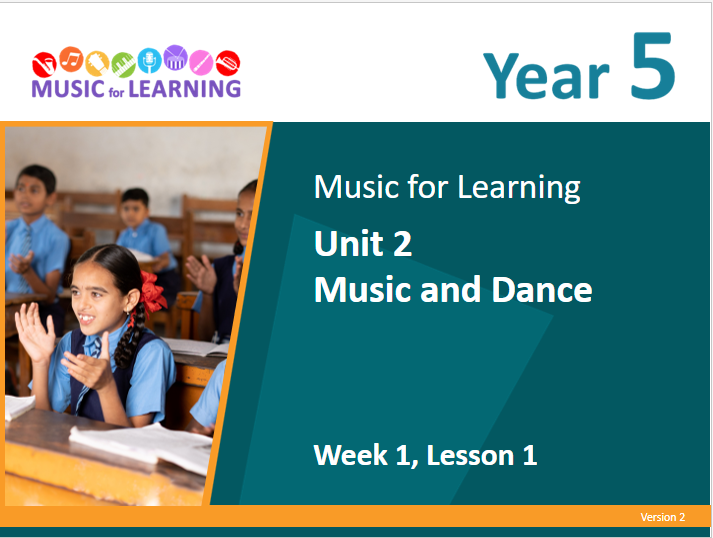
Year 5: Music and Dance
Teaching Resources
- Lesson 1
- Lesson 2 (Coming Soon)
- Teaching Guide
- Student Workbook
Australian Curriculum Content Descriptions
Year 5 Unit 2: Music and Dance is a Music unit for Year 5 students. It aligns to the Australian Curriculum Content Description:
- AC9AMU6E01
Explore the ways that the elements of music are combined in music across cultures, times, places and/or other contexts.
- AC9AMU6E02
Explore ways First Nations Australians use music to continue and revitalise culture.
- AC9AMU6D01
Develop listening/aural skills and skills for manipulating elements of music to achieve expressive effects when composition, singing, and playing instruments.
- AC9AMU6C01
Manipulate elements of music and use compositional devices to communicate ideas, perspectives and/or meaning when composing and practising music for performance, and notate, document and/or record the music they compose.
- AC9AMU46P01
Perform music in a range of forms they have learnt and/or composed in informal and/or formal settings.
Learning Objectives
Year 5 Lesson 1 Series:
Students will:
- visually and aurally identify simple time rhythms including tikatika, ti-tika and tika-ti
- notate rhythms in simple triple time
- introduce fa to their knowledge and understanding of sol-fa
- revise s, and l,
- learn the key of F Major and the function of a flat
- devise and explain how movement and tempo can tell a story
- analyse and evaluate ‘Moth’ by Bangarra Dance Theatre
- learn the musical terms for tempo
- sing in unison and in a 3 or 4-part round
- complete a performing and presenting assessment based on the folk song, ‘Cedar Swamp’
Year 5 Lesson 2 Series:
Students will:
- learn a new rhythmic unit: tim-ka
- notate and aurally and visually identify an anacrusis
- memorise an American Appalachian circle dance and movement for ‘Nigun Atik’
- explore dances of our First Nations Peoples
- sing and perform ‘Oh, How Lovely,’ ‘Do Se So,’ ‘Alligator Hedgehog,’ and ‘Old Joe Clark’
- learn to memorise and perform in different formations
Assessment
End-of-Unit Assessment
The End-of-Unit
Assessment occurs at the end of the unit and usually includes a performing, composing or responding task. Composing tasks are usually completed progressively throughout the unit, and assessed at the end. All assessment resources are contained within the teaching resources.
Love what you see? Explore hundreds of FREE lessons in My School Box – join FREE today!